

The Upside
A Hockey Town in the Desert | Roadrunners President Bob Hoffman on Tucson’s Sports Economy
June 25, 2026
-
 play_arrow
A Hockey Town in the Desert | Roadrunners President Bob Hoffman on Tucson’s Sports Economy Edmund Marquez
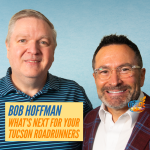

Tucson may be known for sunshine, saguaros, and summer heat — but according to Tucson Roadrunners President Bob Hoffman, it has also become something else: a real hockey town.
In this episode of The Upside, host Edmund Marquez sits down with Bob Hoffman for a wide-ranging conversation about professional sports, the future of hockey in Southern Arizona, and what it takes to build a loyal fan base in a market that many outsiders might never expect to embrace the ice. Edmund brings his own perspective as President of the Tucson Sugar Skulls, making this a rare conversation between the leaders of two professional sports organizations sharing the Tucson Convention Center and helping shape the city’s live sports identity.
The result is more than a hockey interview. It is a look at Tucson’s growing sports economy, the business behind local teams, and the way sports can help bring people downtown, support families, create traditions, and build civic pride.
The Roadrunners and the Future of Hockey in Arizona
Bob explains why the Tucson Roadrunners are different from what some casual fans may think of as “minor league” sports. As an AHL team, the Roadrunners are directly connected to the NHL pipeline. The players fans see in Tucson are not far removed from the highest level of hockey in the world. Many are developing their game, building strength, learning how to be professionals, and preparing for the speed and physicality of the NHL.
That connection became even more interesting after the Arizona Coyotes moved and the Roadrunners continued their affiliation with what is now the Utah Mammoth. Bob walks through how that move changed the logistics of player movement, travel, partnerships, and Arizona’s hockey landscape. What used to be a quick drive up the freeway has become a more complicated operation involving flights, timing, and coordination with wherever the NHL club happens to be playing.
But the bigger story is what this means for Tucson. With the Coyotes gone from Arizona, the Roadrunners now carry an even more important hockey identity in the state. Tucson has proven that fans will show up, youth hockey will grow, and the sport can thrive in the desert.
The Business Behind the Game
Edmund and Bob also dig into the realities most fans never see: leases, travel costs, TV deals, arena schedules, player development, franchise value, and the constant effort to compete for attention in a crowded entertainment world.
For Edmund, the comparison between the Sugar Skulls and Roadrunners opens up a larger conversation about where local professional sports fit into today’s media environment. Sports still have the power to gather people in person and generate attention across platforms. But building that audience requires more than putting a team on the field or the ice. It takes theme nights, community partnerships, entertainment value, affordable family experiences, strong operations, and a team brand that people recognize even if they are not die-hard fans.
Bob shares that the Roadrunners have spent ten years building exactly that kind of foundation. The team has become a winter entertainment option for families, sports fans, and downtown visitors. It has also built a community footprint, raising and donating more than $1.2 million back into the community over the past decade.
That is the deeper Upside story: professional sports are not just games. They are local businesses, community platforms, downtown activity drivers, and identity builders.
Mosaic Quarter, Ice Demand, and Tucson Becoming a Sports City
One of the strongest parts of the conversation is the discussion of Mosaic Quarter, the major sports and entertainment development planned near Kino Parkway and Ajo Way. For Tucson hockey, Mosaic Quarter could solve a real operational problem: ice access.
Right now, when the Tucson Convention Center ice is unavailable because of events like the Gem Show or Disney on Ice, the Roadrunners can lose access to local practice ice. That means extra travel, hotel nights, bus rides, and wear on the players. Bob explains how additional ice sheets at Mosaic Quarter could allow the team to stay in Tucson, practice locally, and reduce the disruption that comes when the arena schedule gets crowded.
The project also speaks to a much bigger demand. Youth hockey and adult hockey have grown in Southern Arizona, and the city needs more infrastructure to support that growth. Mosaic Quarter could become a major piece of Tucson’s sports future, not only for hockey but for the region’s broader development as a sports, recreation, and entertainment destination.
For more on Mosaic Quarter, watch Edmund’s conversation with Lindsay Knott here:
https://www.youtube.com/watch?v=mljeUdcID_0
The Upside: Tucson Is Becoming a Sports City
Bob’s closing message is simple and powerful: Tucson is a hockey market, and hockey has a long future here.
That same message applies to the larger sports landscape. Between the Roadrunners, the Sugar Skulls, FC Tucson, the University of Arizona, youth sports, Mosaic Quarter, and a growing downtown entertainment scene, Tucson is becoming a true sports city.
So support local sports. Bring your family downtown. Fill the seats. Create the traditions.
Visit the Tucson Roadrunners website to pick up season tickets for the 2026–27 season — on sale now:
https://www.tucsonroadrunners.com/tickets/season-ticket-membership
And don’t miss the next Tucson Sugar Skulls game live at the Tucson Convention Center. Indoor football is fast, loud, affordable, and an incredible experience in person:
https://tucsonsugarskulls.com/
The Upside is made possible with support from The Heath Team at Nova Home Loans, the Tucson Sugar Skulls, and Lumify Creative Agency.